Sunrise and Sunset Times in Ottawa — Complete Guide
Contents
Ottawa's Annual Sunrise and Sunset Overview
Ottawa, Ontario sits at latitude 45.42° N and longitude 75.70° W, placing it in the heart of Canada's eastern time zone. This geographic position creates one of the most dramatic annual swings in daylight of any major Canadian city. Over the course of a year, Ottawa gains nearly 7 hours of daylight between the winter solstice and summer solstice — from approximately 8 hours 47 minutes on December 21 to 15 hours 37 minutes on June 21.
The city's sunrise and sunset times are governed by three primary astronomical factors: the Earth's 23.5-degree axial tilt, Ottawa's distance from the equator, and the city's position within the Eastern Time Zone. Together, these factors create a predictable but fascinating annual cycle that affects everything from daily routines to outdoor recreation, photography, and energy consumption.
Throughout this guide, we'll provide comprehensive sunrise and sunset data for Ottawa, help you understand the patterns, and show you how to use this information to plan your activities. For real-time calculations on any specific date, our Ottawa Sunset Calculator provides precise astronomical data.
Monthly Sunrise and Sunset Times for Ottawa
The following table shows approximate sunrise and sunset times for the 15th of each month in Ottawa. Times are shown in local time (EST or EDT as applicable). Note that daylight saving time begins the second Sunday of March and ends the first Sunday of November.
| Month | Sunrise | Sunset | Day Length | Change from Prior Month |
|---|---|---|---|---|
| January 15 | 7:39 AM EST | 4:47 PM EST | 9h 08m | +18 min |
| February 15 | 7:04 AM EST | 5:33 PM EST | 10h 29m | +1h 21m |
| March 15 | 7:13 AM EDT | 7:12 PM EDT | 11h 59m | +1h 30m |
| April 15 | 6:18 AM EDT | 7:55 PM EDT | 13h 37m | +1h 38m |
| May 15 | 5:35 AM EDT | 8:30 PM EDT | 14h 55m | +1h 18m |
| June 15 | 5:14 AM EDT | 8:53 PM EDT | 15h 39m | +44m |
| July 15 | 5:31 AM EDT | 8:45 PM EDT | 15h 14m | -25m |
| August 15 | 6:07 AM EDT | 8:08 PM EDT | 14h 01m | -1h 13m |
| September 15 | 6:46 AM EDT | 7:12 PM EDT | 12h 26m | -1h 35m |
| October 15 | 7:22 AM EDT | 6:15 PM EDT | 10h 53m | -1h 33m |
| November 15 | 6:56 AM EST | 4:35 PM EST | 9h 39m | -1h 14m |
| December 15 | 7:29 AM EST | 4:22 PM EST | 8h 53m | -46m |
The most dramatic month-over-month changes occur in March-April (gaining ~1.5 hours per month) and September-October (losing ~1.5 hours per month). These rapid transitions are when Ottawa residents notice daylight changes most dramatically in their daily lives.
Seasonal Sunrise and Sunset Patterns
Spring (March - May)
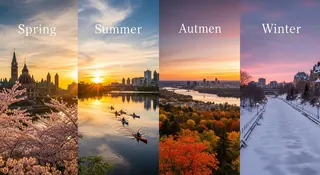
Spring is the season of rapidly increasing daylight in Ottawa. The city gains approximately 6 hours and 48 minutes of daylight between March 1 and June 1. This period sees the fastest daily changes in both sunrise (getting earlier) and sunset (getting later). The spring equinox around March 20 marks the point of roughly equal day and night, with sunrise near 7:00 AM EDT and sunset near 7:15 PM EDT.
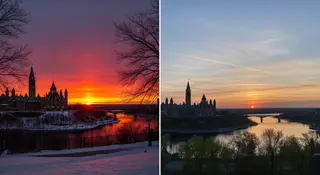
Spring sunsets in Ottawa are particularly beautiful because the thawing Ottawa River creates atmospheric moisture that catches and scatters the warm sunset light. The combination of clearing winter skies and spring moisture often produces vivid orange and pink sunsets.
Summer (June - August)
Summer brings Ottawa's longest days, with the peak occurring at the June solstice. During this period, sunrise occurs before 5:15 AM EDT and sunset doesn't happen until nearly 9:00 PM EDT. The extended evening light is one of the most cherished aspects of Ottawa summers, allowing for late outdoor dining, evening cycling along the canal, and long twilight photography sessions.
The rate of daylight change slows dramatically near the solstice — from mid-June to early July, sunset time barely changes, shifting by less than 30 seconds per day. This creates a wonderful plateau of long evenings that defines the Ottawa summer experience.
Autumn (September - November)
Autumn reverses the spring pattern, with daylight decreasing rapidly. Ottawa loses approximately 6 hours between September 1 and December 1. The fall equinox around September 22 returns the city to roughly equal day and night. Fall sunsets benefit from crisp, clear air and the spectacular autumn foliage of the Gatineau Hills, creating what many consider Ottawa's most photogenic sunset season.
Winter (December - February)
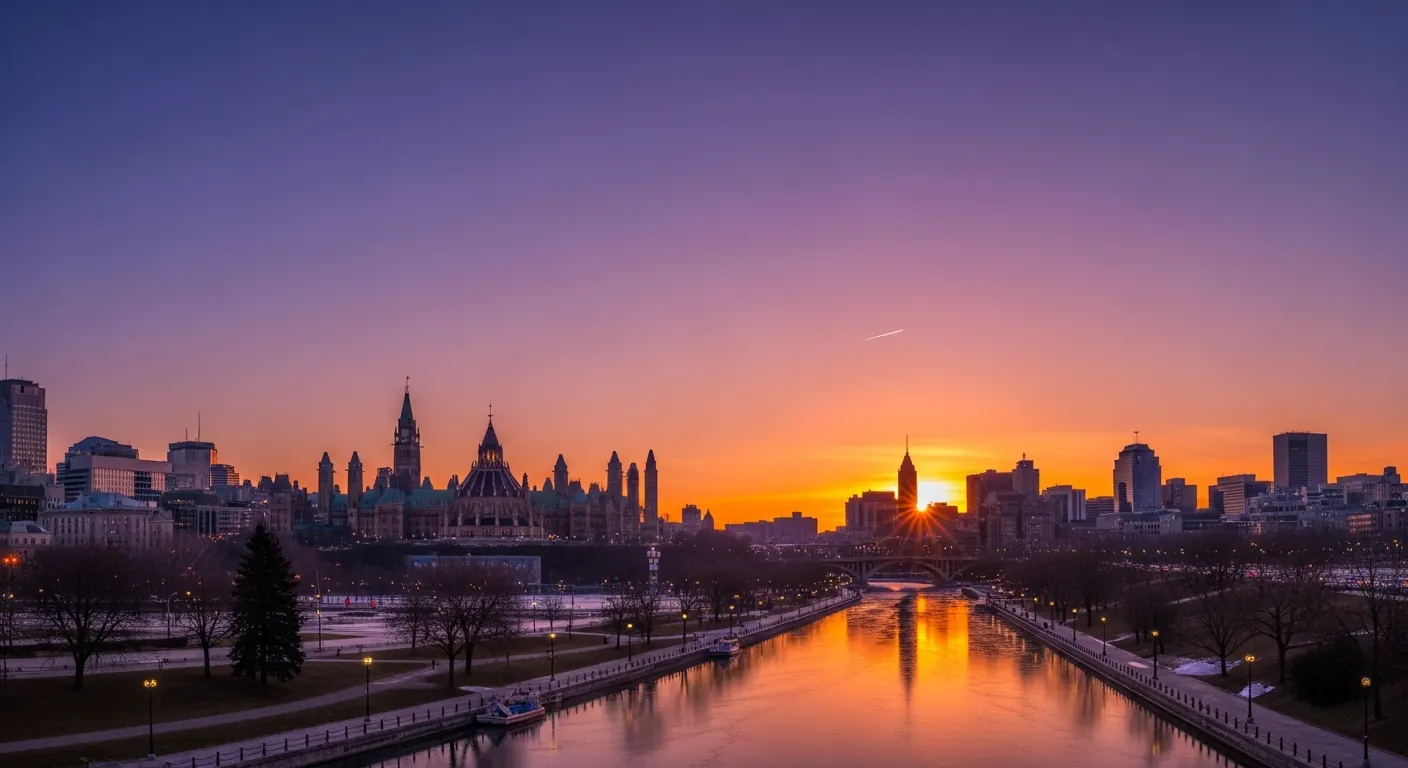
Winter brings Ottawa's shortest days but also some of its most dramatic sunsets. Cold, dry air reduces atmospheric haze, often creating sharp, vivid sunset colors. The winter solstice around December 21 marks the shortest day at approximately 8 hours 47 minutes. After the solstice, daylight gradually returns, with sunrise getting earlier and sunset getting later.
Day Length Throughout the Year in Ottawa
Day length — the time between sunrise and sunset — varies enormously in Ottawa. Here's how it breaks down:
- Shortest day: December 21 — approximately 8 hours 47 minutes of daylight
- Longest day: June 21 — approximately 15 hours 37 minutes of daylight
- Total variation: 6 hours 50 minutes difference between shortest and longest day
- Equinox days: March 20 and September 22 — approximately 12 hours 10 minutes each
The rate of daylight change is not uniform throughout the year. Ottawa gains daylight fastest in early March (about 3 minutes per day) and loses it fastest in early October (about 3 minutes per day). Near the solstices, the rate slows to near zero.
How Day Length Affects Ottawa Life
These dramatic daylight swings profoundly affect life in the National Capital Region. In winter, many Ottawa commuters drive to and from work entirely in darkness. By contrast, summer's extended daylight allows for outdoor festivals like Ottawa Bluesfest, evening paddling on the Ottawa River, and long sunset-watching sessions at Britannia Beach.
The transitional seasons bring their own character. Spring's rapidly lengthening days create a palpable sense of optimism across the city, while autumn's shortening evenings drive Ottawans to savor each remaining sunset. Understanding these patterns helps you make the most of every season's unique light.
Time Zone and Daylight Saving Effects on Ottawa
Ottawa operates on Eastern Time, which places it in the same time zone as Toronto, Montreal, New York, and much of eastern North America. However, Ottawa's position within this time zone significantly affects its sunrise and sunset times compared to other cities in the zone.
Position Within the Time Zone
The Eastern Time Zone spans from approximately 67.5° W to 82.5° W longitude, with its theoretical center at 75° W. Ottawa sits at 75.70° W — almost exactly at the center of the time zone. This means Ottawa's solar noon (when the sun reaches its highest point) occurs very close to 12:00 PM clock time, making the city's sunrise and sunset times relatively symmetric around noon.
Compare this to cities on the edges of the zone: Detroit (83.05° W) sees sunset roughly 30 minutes later than Ottawa, while Halifax (63.57° W) sees sunset roughly 50 minutes earlier. These differences are purely due to position within the time zone, not latitude.
Daylight Saving Time Impact
When Ottawa switches from EST to EDT in March, clocks spring forward one hour. This shifts sunset from approximately 6:15 PM to 7:15 PM overnight — a welcome change that creates the perception of suddenly longer evenings. The reverse occurs in November, when the "fall back" makes sunset seem to leap backward by an hour.
Understanding this distinction between solar time and clock time helps explain why the earliest sunset (around December 10) doesn't coincide with the shortest day (December 21). The equation of time — a correction factor for the Earth's elliptical orbit and axial tilt — causes these dates to diverge by about 10-12 days.
Ottawa vs. Nearby Cities: Sunrise & Sunset Comparison
Ottawa's sunrise and sunset times differ from nearby Canadian cities due to differences in latitude and longitude. Here's how the National Capital Region compares:
| City | Latitude | June Sunset | Dec Sunset | Longest Day |
|---|---|---|---|---|
| Ottawa | 45.42° N | 8:55 PM | 4:22 PM | 15h 37m |
| Toronto | 43.65° N | 9:03 PM | 4:43 PM | 15h 26m |
| Montreal | 45.50° N | 8:47 PM | 4:13 PM | 15h 38m |
| Quebec City | 46.81° N | 8:54 PM | 4:05 PM | 15h 52m |
| Gatineau | 45.48° N | 8:55 PM | 4:22 PM | 15h 38m |
Gatineau, Ottawa's sister city across the river, has virtually identical sunrise and sunset times. Montreal, at a similar latitude but further east, sees sunset about 8 minutes earlier. Toronto, being further south and west, has later sunsets but less extreme seasonal variation.
For precise, location-specific calculations, use our sunset calculator which handles any coordinates you provide.
Practical Uses for Sunrise & Sunset Data in Ottawa
Beyond the beauty of watching the sun rise and set, Ottawa's sunrise and sunset times have many practical applications:
Outdoor Recreation Planning
Whether you're planning a sunset hike in Gatineau Park, an evening run along the canal, or a cycling trip on the Ottawa River pathway, knowing when the sun sets helps you plan your activity to finish safely before dark. Our 20 curated sunset locations each include 7-day sunset forecasts for planning ahead.
Photography Planning
Ottawa's sunset photography community relies heavily on precise sunrise and sunset data. Knowing the exact golden hour window allows photographers to be set up and ready when the light is at its most dramatic. Our calculator shows golden hour start and end times for every date.
Event Planning
Outdoor weddings, festivals, and events in Ottawa all benefit from accurate sunset data. A June outdoor reception can count on daylight until nearly 9 PM, while a November event needs indoor lighting by 5 PM. Our monthly calendar guide provides a year-round reference.
Gardening and Agriculture
The Ottawa region's gardening season is closely tied to day length. Many plants respond to photoperiod (day length) rather than temperature for flowering and fruiting. Knowing how many hours of sunlight your garden receives throughout the season is essential for planning crops and ornamental plantings.
Bookmark Sunset Ottawa for daily access to accurate, calculated sunrise and sunset data for the entire National Capital Region.
Frequently Asked Questions
Explore Ottawa's Best Sunsets
Use our interactive tools to find the perfect sunset viewing experience.