Earliest & Latest Sunset in Ottawa — Complete Analysis
Contents
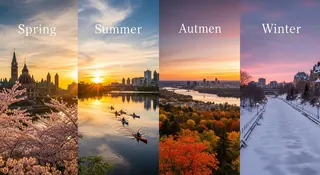
Ottawa's Extreme Sunset Times: A 4.5-Hour Swing
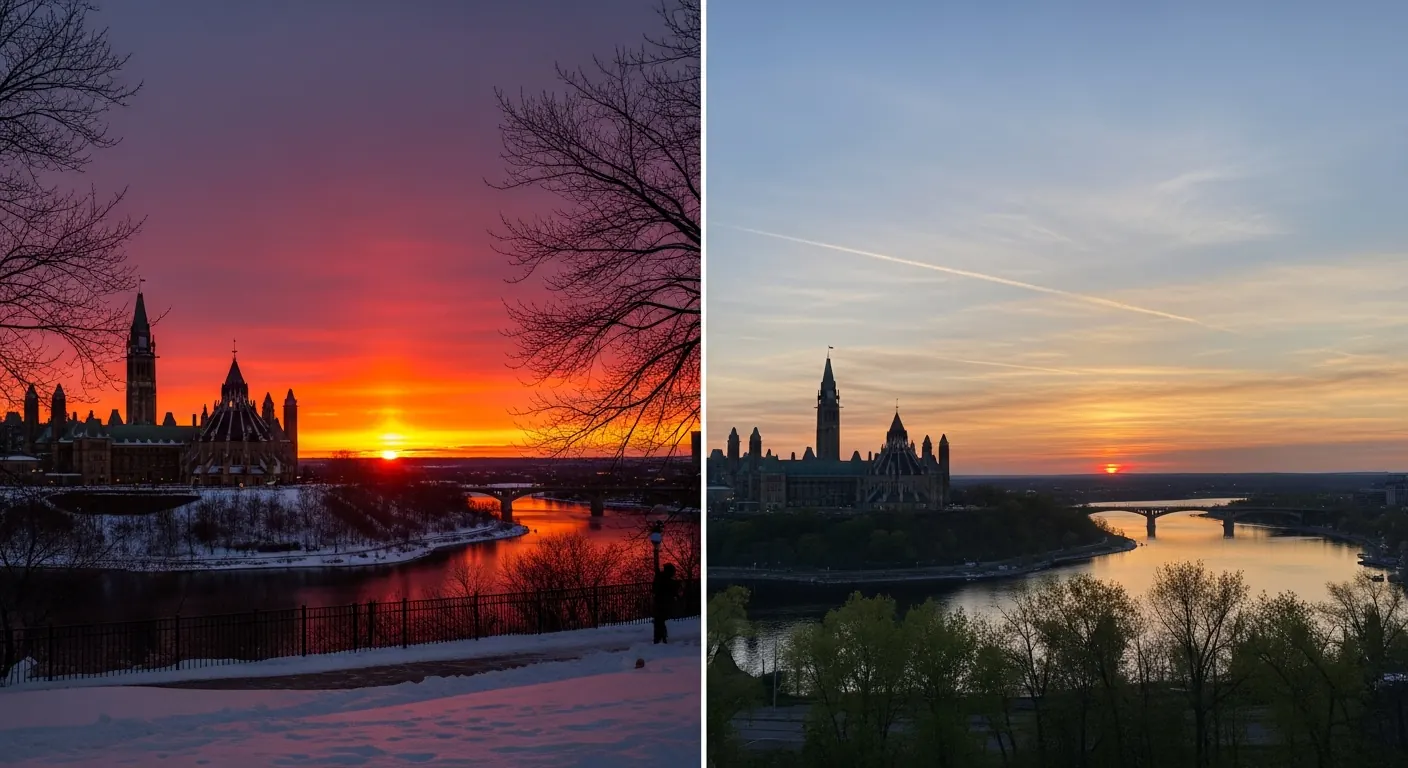
Over the course of a year, Ottawa's sunset time swings by an extraordinary 4 hours and 35 minutes — from the earliest sunset around December 10 at approximately 4:20 PM EST to the latest sunset around June 26 at approximately 8:55 PM EDT. This massive range is one of the largest of any major city in Canada and reflects Ottawa's position at a relatively high northern latitude.
To put this in perspective: on Ottawa's earliest sunset day, it's dark by dinnertime and the city is wrapped in night by 5:30 PM. On the latest sunset day, the sun lingers above the horizon until nearly 9 PM, with useful daylight extending past 10 PM. The difference in atmosphere, mood, and outdoor opportunity between these extremes is profound — and tracking these transitions is one of the great pleasures of living in Ottawa.
What surprises many Ottawa residents is that the earliest and latest sunsets don't fall on the solstices. The winter solstice (shortest day) is around December 21, but the earliest sunset occurs about 10-12 days earlier. Similarly, the summer solstice (longest day) is around June 21, but the latest sunset occurs about 4-7 days later.
Ottawa's Earliest Sunset: December 8-12
The earliest sunset in Ottawa occurs around December 8-12, when the sun drops below the horizon at approximately 4:20 PM EST. For several days around this date, sunset varies by only seconds — creating a brief "plateau" of extremely early darkness.
Key Facts About Ottawa's Earliest Sunset
| Metric | Value |
|---|---|
| Approximate date | December 8-12 |
| Sunset time | ~4:20 PM EST |
| Day length on this date | ~8h 52m |
| Is this the shortest day? | No — shortest day is Dec 21 (~8h 47m) |
| Golden hour start | ~3:15 PM EST |
| Civil twilight end | ~4:55 PM EST |
After the earliest sunset date, sunset begins getting later even though the total day continues to get shorter until the solstice. This seemingly paradoxical behavior occurs because sunrise continues getting later at a faster rate than sunset is getting later. The net effect is that days still shorten, but the shortening comes entirely from later sunrises rather than earlier sunsets.
For many Ottawa residents, the earliest sunset period is psychologically the most challenging time of year. Walking out of work at 4:30 PM into full darkness feels disheartening. But there's a silver lining: after December 10, every single evening gets a tiny bit longer. By December 31, sunset is already 8 minutes later than its earliest point.
Ottawa's Latest Sunset: June 25-28
Ottawa's latest sunset occurs around June 25-28, when the sun lingers above the horizon until approximately 8:55 PM EDT. Like the December counterpart, there's a plateau of several days where sunset barely changes.
Key Facts About Ottawa's Latest Sunset
| Metric | Value |
|---|---|
| Approximate date | June 25-28 |
| Sunset time | ~8:55 PM EDT |
| Day length on this date | ~15h 34m |
| Is this the longest day? | No — longest day is June 21 (~15h 37m) |
| Golden hour start | ~6:45 PM EDT |
| Civil twilight end | ~9:35 PM EDT |
The latest sunset is one of the most celebrated moments in Ottawa's annual cycle. These late June evenings feel almost impossibly long — sunlight that seems to last forever, twilight extending past 10 PM, and the warmth of summer making it comfortable to be outdoors until well after dark. Ottawans flock to Britannia Beach, patios, parks, and the Ottawa River to soak up every minute of this precious extended daylight.
After the latest sunset, evenings begin to shorten — slowly at first (less than 30 seconds per day in early July), then accelerating through the summer and fall. By late September, sunset has retreated to around 7 PM, and the long summer evenings feel like a fading memory.
The Equation of Time: Why Solstices Don't Match Extreme Sunsets
The separation between solstice dates and extreme sunset dates is caused by a fascinating astronomical phenomenon called the "equation of time." Understanding this helps explain one of the most common questions in sunset science.
What Is the Equation of Time?
The equation of time is the difference between "true solar time" (based on the actual sun's position) and "mean solar time" (what our clocks show). Our clocks assume a perfectly uniform solar day of exactly 24 hours, but in reality, the length of a solar day varies throughout the year due to two factors:
- Earth's Elliptical Orbit: Earth's orbit around the sun is not a perfect circle — it's slightly elliptical. When Earth is closer to the sun (perihelion, around January 3), it moves faster in its orbit. When further away (aphelion, around July 4), it moves slower. This changes how long it takes for the sun to appear to complete one daily circuit of the sky.
- Earth's Axial Tilt: The 23.5-degree tilt of Earth's axis causes the sun's apparent motion to have different east-west components at different times of year. Near the solstices, more of the sun's motion is north-south, which doesn't affect the length of the solar day. Near the equinoxes, the motion is more east-west, affecting solar day length.
These two effects combine to create variations of up to ±16 minutes between clock time and solar time throughout the year. In early December, solar noon occurs about 10 minutes before clock noon, which pushes both sunrise and sunset earlier on the clock. This is why the earliest sunset (clock time) occurs before the solstice.
Sunrise Extremes: The Other Half of the Story
The sunset extremes have corresponding sunrise extremes, but they fall on different dates:
| Event | Date | Time |
|---|---|---|
| Earliest sunrise | ~June 14-17 | ~5:13 AM EDT |
| Latest sunrise | ~January 2-5 | ~7:41 AM EST |
| Latest sunset | ~June 25-28 | ~8:55 PM EDT |
| Earliest sunset | ~December 8-12 | ~4:20 PM EST |
Notice the pattern: the earliest sunrise (mid-June) occurs about a week before the summer solstice, while the latest sunset (late June) occurs about a week after. Similarly, the earliest sunset (early December) occurs about two weeks before the winter solstice, while the latest sunrise (early January) occurs about two weeks after.
This means that for Ottawa residents:
- Late December: Sunset is already getting later, but sunrise is still getting later. Evenings improve while mornings stay dark.
- Early January: The latest sunrise occurs, then mornings finally start brightening. Both ends of the day are now improving.
- Late June: Sunrise is already getting later, but sunset is still getting later. The longest evenings come after the solstice.
- Early July: The latest sunset passes, and evenings begin to shorten. Both ends of the day are now contracting.
How to Track Sunset Changes Throughout the Year
If you're fascinated by the annual dance of Ottawa's sunrise and sunset times, here are ways to track and appreciate the changes:
Use Our Calculator
Our Ottawa Sunset Calculator provides precise times for any date. Compare dates across the year to see how rapidly or slowly sunset is changing. Try comparing December 1 vs. January 1 to see the early winter turnaround, or June 1 vs. July 1 to see the summer solstice plateau.
Weekly Comparisons
Each of our 20 sunset locations includes a 7-day sunset forecast. Checking weekly reveals patterns that daily observation might miss — especially the rapid spring and fall transitions when sunset shifts by nearly 20 minutes per week.
Key Transition Dates to Watch
- ~December 10: Earliest sunset — evenings start improving from here
- ~January 3: Latest sunrise — mornings start improving from here
- ~February 1: Sunset reaches 5:00 PM — noticeable evening improvement
- ~March (DST switch): Sudden jump in apparent sunset time
- ~March 20: Spring equinox — equal day and night
- ~June 15: Earliest sunrise — mornings at their brightest
- ~June 26: Latest sunset — evenings at their longest
- ~September 22: Fall equinox — equal day and night again
- ~November (DST switch): Sudden jump backward in sunset time
Understanding these milestones helps you appreciate the grand annual cycle that governs Ottawa's light. For the precise times on any date in the cycle, visit our sunset calculator.
Frequently Asked Questions
Explore Ottawa's Best Sunsets
Use our interactive tools to find the perfect sunset viewing experience.