Ottawa Sunset & Weather Conditions — Predicting Spectacular Sunsets
Contents
How Weather Shapes Ottawa's Sunsets
Every Ottawa sunset is unique, and the primary reason isn't astronomical — it's meteorological. While the sun follows a predictable path across the sky, the atmosphere through which its light passes changes constantly. Cloud formations, humidity levels, air quality, and atmospheric pressure all combine to determine whether tonight's sunset will be a muted affair or a jaw-dropping spectacle.
Understanding the relationship between weather and sunset quality turns you from a passive observer into an active predictor. With practice, you can scan the afternoon sky and weather forecast and accurately predict whether tonight's sunset is worth the trip to Britannia Beach or whether you should save your outing for tomorrow.
Ottawa's position in the Ottawa Valley, at the confluence of three rivers, and on the boundary between the Great Lakes and St. Lawrence weather systems, creates dynamic weather patterns that produce a wide range of sunset conditions. This variety is actually an advantage — Ottawa sees more diverse sunset types than many cities with more stable climates.
Cloud Cover: The #1 Factor in Sunset Quality
Clouds are the single most important factor determining sunset quality. Without clouds, the sunset display is limited to a narrow band of warm color at the horizon. With the right clouds, the entire sky becomes a canvas of color. Here's how different cloud types affect Ottawa sunsets:
High Clouds (Best for Sunsets)
- Cirrus: Thin, wispy ice-crystal clouds at 6,000-12,000 meters. These catch sunset light from great distances, often coloring before the sun even reaches the horizon. Cirrus clouds produce elegant, delicate sunset displays with soft pink and orange hues. Common before approaching weather systems — if you see increasing cirrus, tonight's sunset may be excellent.
- Cirrostratus: A thin, translucent veil of high cloud. Can create halo effects around the setting sun and produces soft, pastel-colored sunsets.
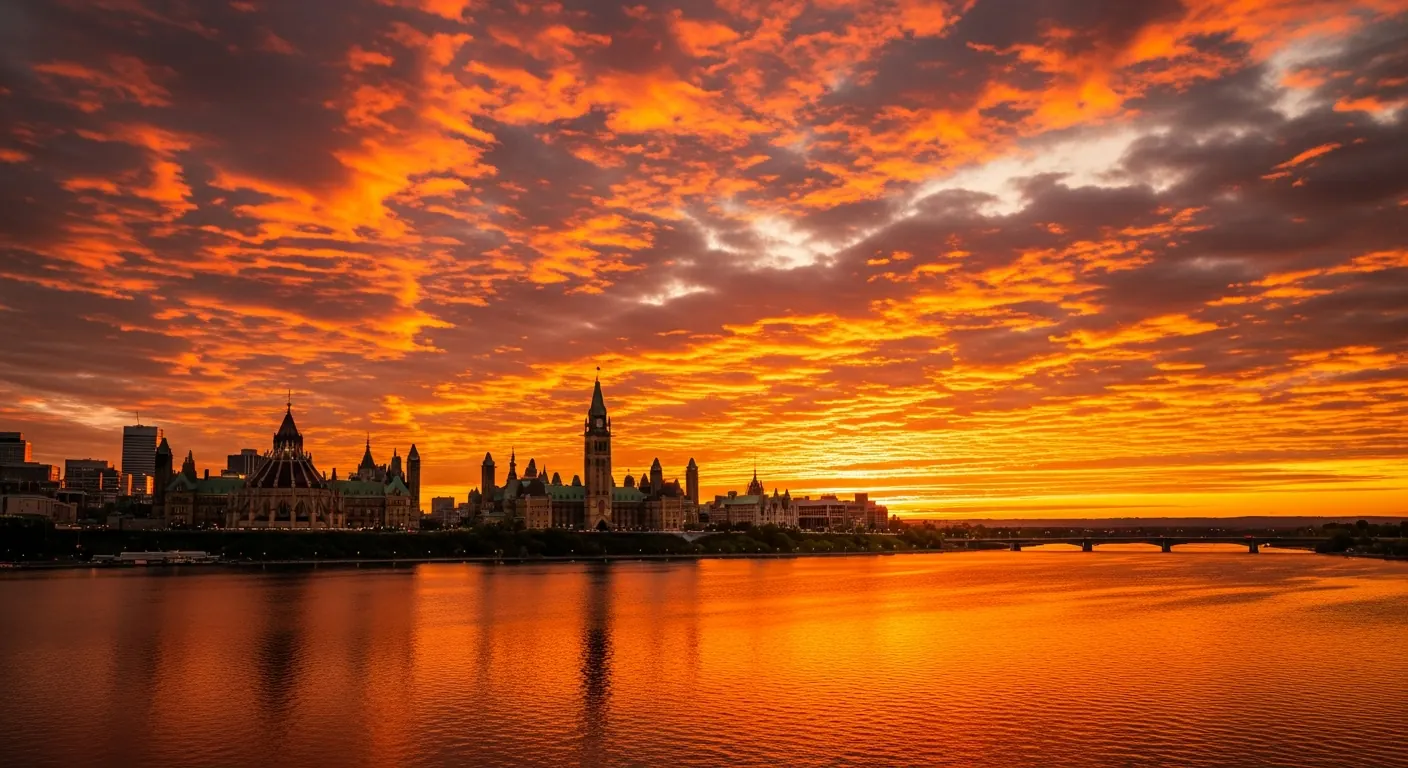
- Altocumulus: Mid-level clouds (2,000-6,000 m) that form a textured, mackerel-like pattern. These are sunset gold — their undersides light up individually, creating a dramatic mosaic of color across the sky. An altocumulus sky at sunset is almost guaranteed to be spectacular.
Low Clouds (Mixed Results)
- Cumulus: Puffy, white daytime clouds. If they clear from the western horizon while remaining overhead, they can catch sunset light from below — producing vivid, dramatic displays. If they block the western horizon, the sunset is obscured.
- Stratus: Flat, gray, featureless cloud layers. These typically block sunset light entirely. However, if there's a gap between the stratus layer and the western horizon, the sun can shine under the cloud deck and illuminate the base — creating what photographers call "the breakthrough" — one of the most dramatic sunset scenarios.
The Ideal Cloud Scenario
The most spectacular Ottawa sunsets typically occur with 30-70% cloud coverage, predominantly mid-to-high clouds, with a clear or partially clear western horizon. This allows the setting sun to illuminate cloud undersides from below while the clouds provide surfaces to display the colors.
Atmospheric Conditions That Enhance Sunsets
Humidity and Moisture
Moderate humidity enhances sunset colors by providing additional particles for light scattering. However, too much moisture creates haze that mutes colors and reduces contrast. Ottawa's optimal sunset humidity range is approximately 40-65%.
- Low humidity (<30%): Common in winter. Produces sharp, vivid sunsets with clear color boundaries. Colors tend toward intense reds and oranges.
- Moderate humidity (30-65%): Ideal range. Enough moisture to scatter light beautifully without creating haze. Rich, saturated colors with good contrast.
- High humidity (>65%): Common in summer. Can create soft, pastel-colored sunsets or hazy, muted displays depending on conditions. Very high humidity may reduce visibility.
Air Quality
Ottawa generally has good air quality, but conditions vary. Clean air after a rain shower or cold front passage produces the most vivid, clear sunsets. Wildfire smoke (unfortunately increasingly common in Ottawa summers) creates dramatically red sunsets but reduces air quality and visibility.
Atmospheric Pressure
Falling pressure often indicates approaching weather systems with cloud formations that enhance sunsets. The day before a storm often produces spectacular sunsets as high clouds advance ahead of the weather front. Rising pressure after a storm indicates clearing skies — the post-storm sunset is frequently exceptional as clean, rain-washed air produces vivid colors.
How to Predict Tonight's Sunset Quality
Here's a practical scoring system for predicting Ottawa sunset quality based on observable conditions:
The Ottawa Sunset Score (0-10)
Rate the following conditions and add up points:
- Cloud cover 30-70% with mid/high clouds: +3 points
- Clear western horizon (sun visible): +2 points
- Recent rain or cold front passage (clean air): +2 points
- Moderate humidity (not too hazy): +1 point
- Altocumulus clouds present: +1 point
- Cirrus clouds visible to west: +1 point
Deductions:
- Complete overcast (no breaks): -5 points
- Heavy haze or smog: -3 points
- Rain/storms at sunset time: -4 points
- Completely clear sky (no clouds): -1 point (still nice, just less dramatic)
Score Interpretation
- 8-10: Drop everything and go. This will be an exceptional sunset. Bring your camera to the best spot possible.
- 5-7: Worth the trip. Good conditions for a beautiful sunset. Head to your nearest sunset spot.
- 3-4: Might be decent. Worth watching from a convenient location but maybe not worth a special trip.
- 0-2: Probably not tonight. Save your outing for a better forecast. Check tomorrow's conditions.
Seasonal Weather Patterns and Ottawa Sunsets
Winter (December-February)
Arctic air masses bring Ottawa's clearest, driest air, producing the sharpest and most vivid winter sunsets. Cold front passages are frequent, and the post-front clearing often produces exceptional sunset conditions. Ice crystal clouds (cirrus) at high altitude add delicate texture to winter sunset skies.
Spring (March-May)
Spring brings increasingly active weather with a mix of cloud types. The transition between cold and warm air masses creates dramatic cloud formations. Thunderstorm anvils catching sunset light from below can produce extraordinary (and brief) sunset displays. Spring's increasing moisture adds soft warmth to sunset colors.
Summer (June-August)
Higher humidity can create hazy sunsets, but summer also brings dramatic thunderstorm anvils that catch sunset light spectacularly. The best summer sunsets often occur after afternoon thunderstorms clear out, leaving washed air and scattered clouds that catch the evening sun. During wildfire seasons, smoke particles can create intensely red sunsets, though air quality may be poor.
Fall (September-November)
Many sunset experts consider autumn Ottawa's finest sunset season. The combination of increasingly clear air, active weather fronts, and optimal humidity creates vivid, high-contrast sunsets. Fall's advancing cold fronts produce regular cycles of cloud buildup followed by clearing — each cycle potentially producing a spectacular sunset.
Weather Resources for Ottawa Sunset Prediction
Use these resources to predict Ottawa's sunset quality:
Weather Forecasts
- Environment Canada — Ottawa: The most reliable forecast for Ottawa weather. Check the evening outlook for cloud coverage, precipitation probability, and humidity
- Satellite imagery: Real-time satellite images show current cloud positions and movement patterns. Available from Environment Canada's weather website
Our Tools
- Sunset Calculator: Get today's exact sunset time and golden hour window
- Location Guide: Each location includes a 7-day sunset forecast
- Daily Sunset Times: Always current sunset information
The 3-Hour Check
For the best sunset prediction accuracy, check conditions approximately 3 hours before sunset. By this time, the afternoon's weather pattern is established, and you can see what clouds are developing or clearing. Look west — what's happening to the west of Ottawa is what will be overhead at sunset time (weather generally moves west to east).
Frequently Asked Questions
Explore Ottawa's Best Sunsets
Use our interactive tools to find the perfect sunset viewing experience.